
Guided Journal
You’re Allowed to Question
A guided journal for religious deconstruction, healing from spiritual trauma and rebuilding self-trust
For the in-between: when you’ve started to step away from inherited beliefs, but you aren’t sure what comes next. No new rules, no agenda, just room to think for yourself.
Find it on Amazon“I found myself writing about things that had been locked in for so long.” Richard Dale, verified purchase
About the Journal
You’ve already done something brave. You allowed yourself to wonder. To pause. To ask, what if this doesn’t feel true anymore.
This journal is for that in-between, after you’ve started to step away from inherited beliefs and before you know what replaces them. It won’t tell you what to believe. It isn’t another guidebook or doctrine or map with arrows pointing at the right way, and you’ve had enough of those.
What it offers instead is space. More than a hundred writing prompts covering grief, guilt, fear and forgiveness, asking what you believed, what it cost you and what you now choose to reclaim. Affirmations and guided meditations for the days when your nervous system is louder than your thinking. Creative reflection pages and tear-out poems to carry with you. 170 pages, in two sizes, with room to actually write rather than fill in a line.
A prompt from Part 1 gives you the measure of it. “What was never safe to say out loud was…” followed by three unfinished sentences and a page of blank lines. This may be one sentence. Or a page. Or a memory.
It was written by someone who has been through it. Georgia knows what it’s like to lose the scaffolding of certainty and still want to build something true, to carry guilt that wasn’t hers, to grieve a community and to miss a version of belonging while still choosing herself.
Look inside
A flip-through of the large edition.
What’s inside
More than a hundred prompts across four parts, and you don’t have to take them in order.
- Part 1: Unravelling
Noticing what no longer fits, and letting yourself un-know. Several readers say this is the section that stopped them in their tracks. - Part 2: Releasing
The guilt, the fear and the shame that stayed behind after the belief went. - Part 3: Reclaiming
Your own voice, your own judgment, and the things you want to keep. - Part 4: Integration
Living with what you’ve worked out, and building something that feels true to you. - Tear-out pages and meditations
Affirmation cards and poems to pull out and keep, and a list of the guided meditations linked by QR code throughout.
From the Pages
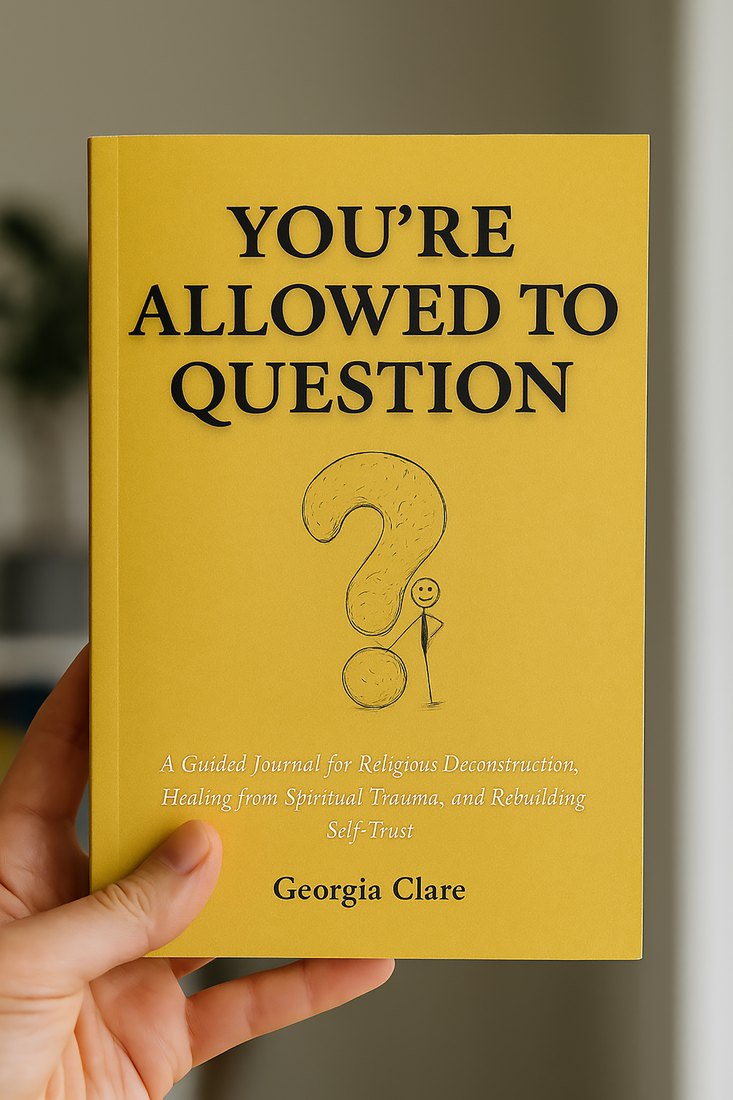
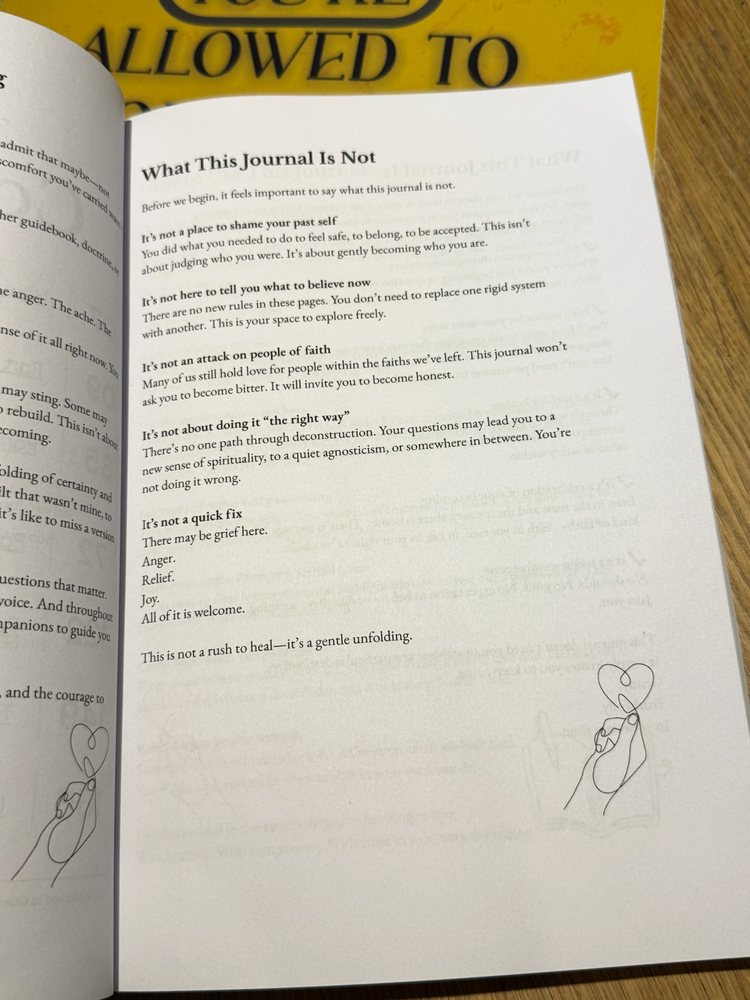
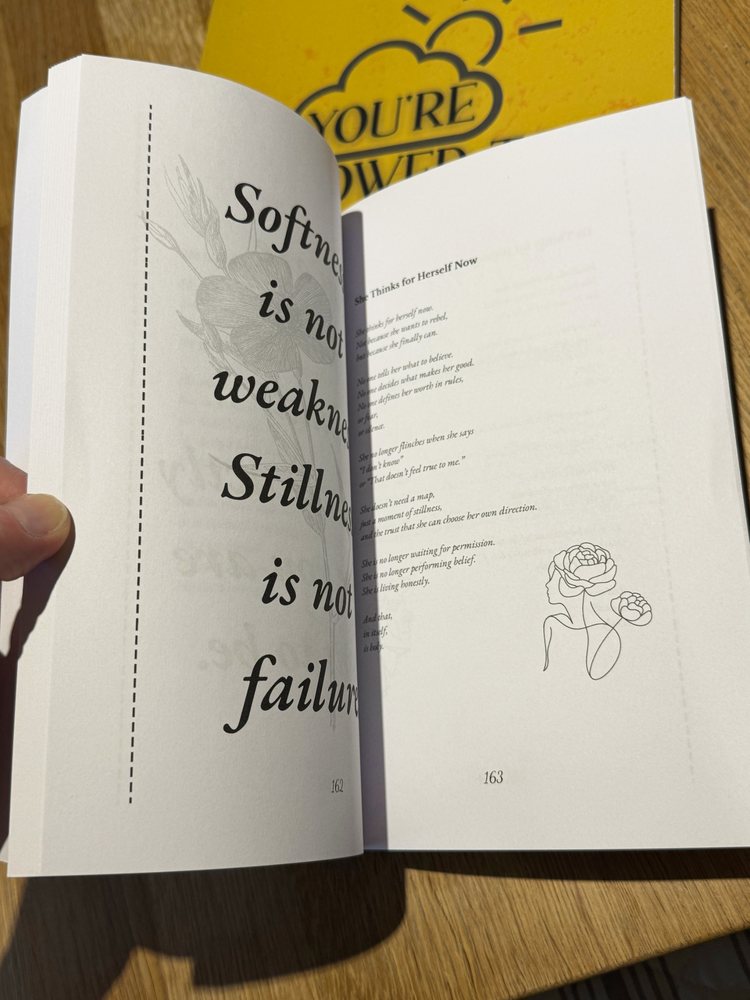
“You don’t need to have the answers. You just need space to ask the questions.”
“It’s not a place to shame your past self. You did what you needed to do to feel safe, to belong, to be accepted.”
“There are no new rules in these pages. You don’t need to replace one rigid system with another.”
“Many of us still hold love for people within the faiths we’ve left. This journal won’t ask you to become bitter. It will invite you to become honest.”
“Softness is not weakness. Stillness is not failure.”
“She no longer flinches when she says ‘I don’t know’ or ‘That doesn’t feel true to me.’”
“You don’t have to hold it all perfectly. You don’t have to make sense of it all right now. You only have to be honest. With yourself.”
“This isn’t a test. There’s no grade, no judgment. Just you, your truth, and the courage to explore it.”
“This isn’t a manual. It’s a soft place to land while you remember who you were before the rules.”
“Leaving a strict religion or high-control community can shake your world, your beliefs, your relationships, even your sense of self.”
Who it’s for
Anyone leaving a high-control religious environment or faith system, whichever one it was. Readers have come to it after the Jehovah’s Witnesses, after evangelical and fundamentalist upbringings, and after communities that had no name for what they were doing.
It suits the people who find most of the available material either too clinical or too preachy in the opposite direction. There’s no deprogramming language in it and no new belief system waiting at the end.
And it’s for the leftovers. A good number of readers say they stopped believing years ago and still carried the guilt and the fear around with them, never having had anywhere to put it down.
What Readers Are Saying
Reviews from readers on Amazon.
★★★★★
Perfect Prompts
I so wanted to find a way to journal my thoughts about escaping being a Jehovah’s Witness, after being one for more than 30 years, and this book could not be more perfect. The prompts are spot on, and I found myself writing about things that had been locked in for so long.
It is incredibly healing, and at the same time helped affirm everything I am now doing. It is a celebration of survival and restarting. I cannot recommend the book highly enough.
★★★★★
Excellent Journal
Leaving a high-control religion is one of the most disorienting experiences a person can go through, and most resources either feel too clinical or too preachy in the opposite direction. This journal hits a completely different note: it’s gentle, non-judgmental, and genuinely meets you where you are.
The prompts don’t push you toward any particular conclusion, which I appreciated more than I expected. They just create space to actually think and feel without the pressure to land somewhere specific. The tear-out affirmation cards and QR-linked meditations are thoughtful extras, not filler.
Compact enough to keep private, deep enough to actually move the needle. If you’re somewhere in the middle of figuring out who you are after leaving a controlling community, this is a quiet, steady companion.
★★★★★
A well structured journal for working through religious trauma
When I saw this book, I realised I still had a lot of leftover guilt and fear from my religious upbringing that I never actually worked through. Even after I stopped believing, those thoughts were still there.
The prompts are simple and direct, but they make you think. A few of them made me stop and realise I had been holding onto ideas I never really questioned. Writing things out helped me sort through where those beliefs came from and whether they still make sense to me.
I also like how the book is structured. It gives you enough space to actually write, not just quick one-line answers.
★★★★★
Comforting and Grounding
Leaving a high-control religious environment can feel disorienting in ways that are hard to explain, and this journal really understands that. Instead of pushing answers or telling you what to believe next, it creates space to slow down and reconnect with your own thoughts and feelings.
The prompts are thoughtful without being overwhelming, and the layout is calm and uncluttered, which actually makes a difference when you’re already emotionally overloaded. I appreciated the tone most of all: it feels kind, patient, and nonjudgmental.
This isn’t about rushing healing or replacing one set of beliefs with another. It’s about learning to trust your own voice again, one page at a time.
★★★★★
Finally, permission to ask “Wait, what?”
This journal is basically saying out loud what a lot of us needed to hear: you’re actually allowed to question the stuff you were taught. The title alone probably hits hard if you grew up being told that doubt was basically a sin.
It’s a workbook with meditations, so you’re not just reading, you’re actively working through the mess of trying to trust yourself again after being taught not to. It’s not trying to tell you what to believe next, it’s just helping you remember that your own thoughts and feelings are actually valid.
★★★★★
One of the good ones
Didn’t expect it to make me feel so, exposed? But in a good way.
Most books try to give you a map, but this one basically just hands you a flashlight and says, “It’s okay if you’re lost.” The section on Unravelling actually made me stop and realise how many of my beliefs were just things I’d been performing for other people.
It’s messy, it’s quiet, and it doesn’t promise to fix your life by the last page. That made me trust it.
★★★★★
Very good journal to help with healing from beliefs that no longer serve you
This is a wonderful journal with prompts to facilitate reflection and healing. It helps you identify beliefs that may no longer be serving you and address the hurt and pain that it caused you. It has a very gentle and encouraging tone and it also includes links and QR codes to guided meditations. Very thoughtfully put together.
★★★★★
Thoughtful Guided Prompts
This journal is gentle and supportive. The prompts are helping me process feelings without pressure, and the extra meditations are calming. I love the affirmations so far. This journal is a safe space for me to reflect. The added space to write allows me to freely write my feelings.
★★★★☆
Healing slowly, persistently
I really like the style the author used. It sounded like a voice that was experienced with personal trauma. I also liked the very gentle voice used in the writing. There are good questions with ample room for written reflection.
My one major concern was the absence of sufficient “why”s for why the reader now believes something different is true. It seemed to be based mostly on feelings. However, I believe this book can contribute greatly to a healing process.
Common questions
Is this journal anti-religion?
No. Many of us still hold love for people within the faiths we’ve left. The journal won’t ask you to become bitter, and it won’t tell you what to believe instead. It invites you to become honest.
Which size should I choose?
Both editions hold exactly the same 170 pages. The large 8.5 x 11 inch edition gives you more room to write and lies flatter on a desk. The 6 x 9 inch pocket edition is easier to keep private and to carry about.
Do I have to have left already?
No. It’s written for the in-between, when you’ve started to step away but aren’t sure what comes next. There’s no one path through deconstruction, and wherever you are in it is a fine place to begin.
What are the meditations and how do I listen?
Guided audio recordings are linked throughout by QR code, made to go with particular sections. Scan the code with your phone camera and listen. There’s a full list at the back of the book.
Is it only for people leaving the Jehovah’s Witnesses?
No, though plenty of readers come to it from there. It’s written for anyone leaving a high-control religious environment of any kind. There’s also a guided course that follows the same four parts, for anyone who’d rather be walked through it.
Where to find it
Large edition on Amazon
Large, 8.5 x 11 inches, 170 pages · ISBN 978-2-9596981-8-7
Pocket, 6 x 9 inches, 170 pages · ISBN 978-2-9596981-9-4
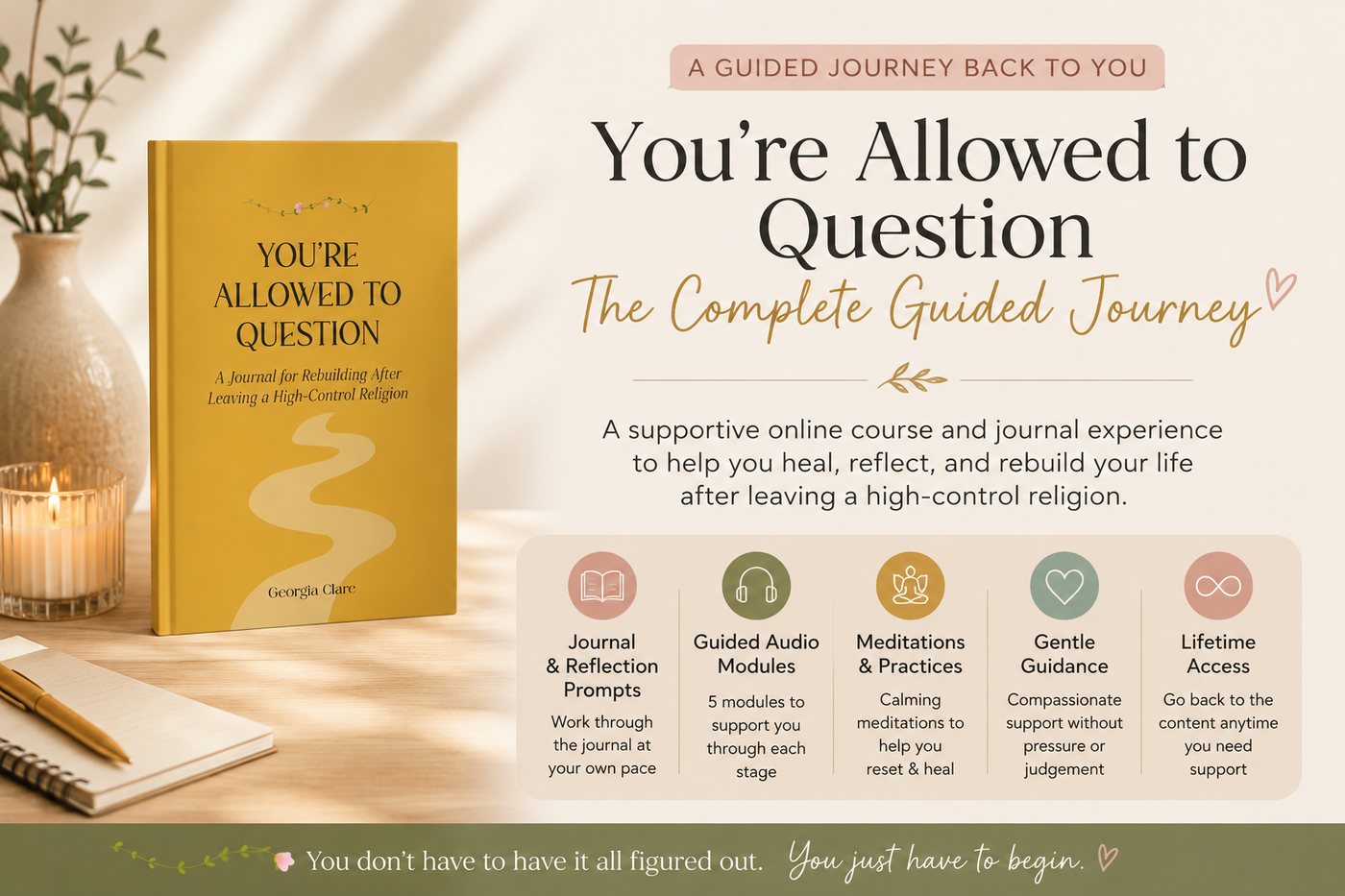
If you’d rather be walked through it
The Complete Guided Journey takes the same four parts and adds five guided audio modules, one for each stage, so you aren’t sitting with a blank page on your own. Meditations and practices throughout, no pressure about pace, and lifetime access so you can go back whenever you need it.
See the course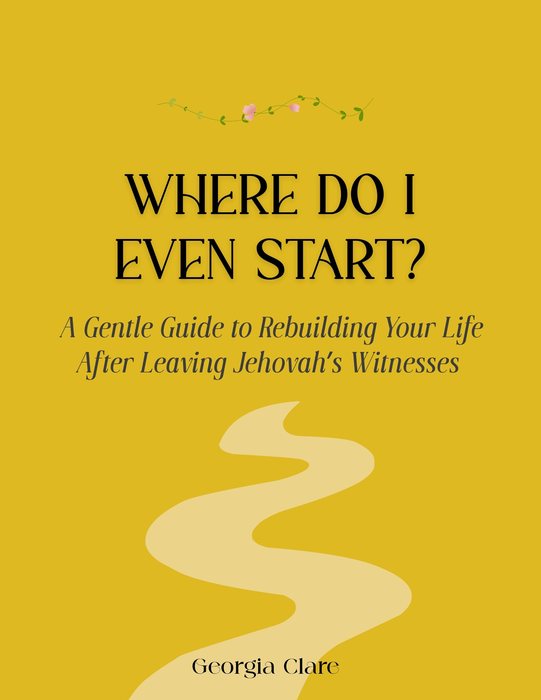
Not ready to buy anything
Where Do I Even Start? is free, and it’s for the very beginning of all this: a gentle guide to rebuilding your life after leaving the Jehovah’s Witnesses. Start there if you want to see how I write before you spend anything.
Get the free guideMeditations to pair
Meditations for unlearning and self-trust
Separate from the ones linked inside the journal, and free to listen to here apart from one premium recording.
Browse the full meditation library →