A Practice
Scientific Prayer: What It Is, and How to Actually Do It
Joseph Murphy used the phrase scientific prayer for something that sounds like a contradiction. Prayer feels spiritual. Science feels measurable. Put together they seem an odd pair.
What he meant was simpler than the name suggests, and it’s something you can practise in about ten minutes a morning. This page is the practical version: what it is, the method as Murphy described it, an example of the wording, and how it fits into an ordinary day.

The Short Answer
What scientific prayer actually means
Most of us learn prayer as asking. Please help. Please let this work. Please make it better. The attention sits on what’s missing.
Scientific prayer turns that around. Rather than asking for circumstances to change, you deliberately and repeatedly hold the thing you want as though it were already so, and you do it with enough feeling that it settles below the level of conscious argument. Murphy’s claim was that the subconscious mind responds to what we repeatedly impress on it, and that it responds to the feeling behind the words rather than the words themselves.
He called it scientific because he thought the principle was consistent, the way gravity is consistent. It’s worth being straight about this: it isn’t scientifically proven in the laboratory sense, and Murphy was writing from the New Thought tradition rather than from psychology. But several of the surrounding ideas do hold up. Repeated thoughts strengthen the pathways we use most. Expectation shapes behaviour. Attention finds what it’s primed to find.
So you can take it as a spiritual practice or as a psychological one. It works the same either way, and it asks you to pay attention to the only part of life you have much influence over.
The Method
How to do it, step by step
This is Murphy’s approach as he set it out, in the order he suggested. None of it takes long. The whole thing fits comfortably into ten minutes.
-
Get quiet and slightly drowsy
Murphy was specific about this. Early morning before you’re properly awake, or last thing at night as you drift off, is when the mind argues least. Sit or lie somewhere comfortable and let your breathing slow. You’re not trying to concentrate hard. You’re trying to stop trying.
-
Decide on one thing, and put it in the present
Pick one. Not a list. And phrase it as though it already is, not as something you’re waiting for. ‘I am calm and steady’ rather than ‘I will be calm one day’. The future tense keeps the thing at arm’s length, which is exactly where you don’t want it.
-
Feel it rather than recite it
This is the part people skip, and it’s the part Murphy thought mattered most. Repeating words you don’t believe achieves very little. Sit with the sensation of the thing being true. What would the relief actually feel like? Stay there for a minute or two.
-
Don’t argue with yourself
If a voice says ‘that isn’t true and you know it’, don’t fight it. Murphy called that effect the law of reverse effort: the harder you push against a doubt, the more you feed it. Instead, choose something you can believe. If ‘I am completely at peace’ gets an argument, try ‘I’m learning to be calmer than I was’. A smaller true thing beats a bigger false one.
-
Finish with thanks, and then let it go
End as though it’s settled. Then get up and stop thinking about it. Checking whether it’s working reintroduces the doubt you just spent ten minutes setting down.
-
Repeat it daily until it stops feeling odd
This is a habit, not an event. Murphy’s whole argument rests on repetition. The first week feels self-conscious. Somewhere around the third it stops feeling like anything much, which is roughly when it starts working.

An Example
What the words might sound like
There’s no correct script, and the wording matters far less than whether you can mean it. But if a blank page is unhelpful, here is the shape of it.
For a peaceful day
I’m quiet for a moment, and I’m not asking for anything.
Peace is already here, and I’m meeting the day from it.
I move through today calmly, at my own pace.
This is a peaceful day, and it belongs to a peaceful week.
Thank you. It is already so.
Read it slowly. Pause after each line long enough to feel what it would be like if it were simply the case. That pause is the practice. The sentences are only there to point at it.
Notice what isn’t in there. No mention of what’s wrong, nothing you’re hoping to avoid, no reference to the difficulty at all. Murphy was firm about this, and I think he was right. Naming the thing you don’t want puts your attention straight back on it, which is the opposite of what you sat down to do. Keep the words on what you’re moving towards.
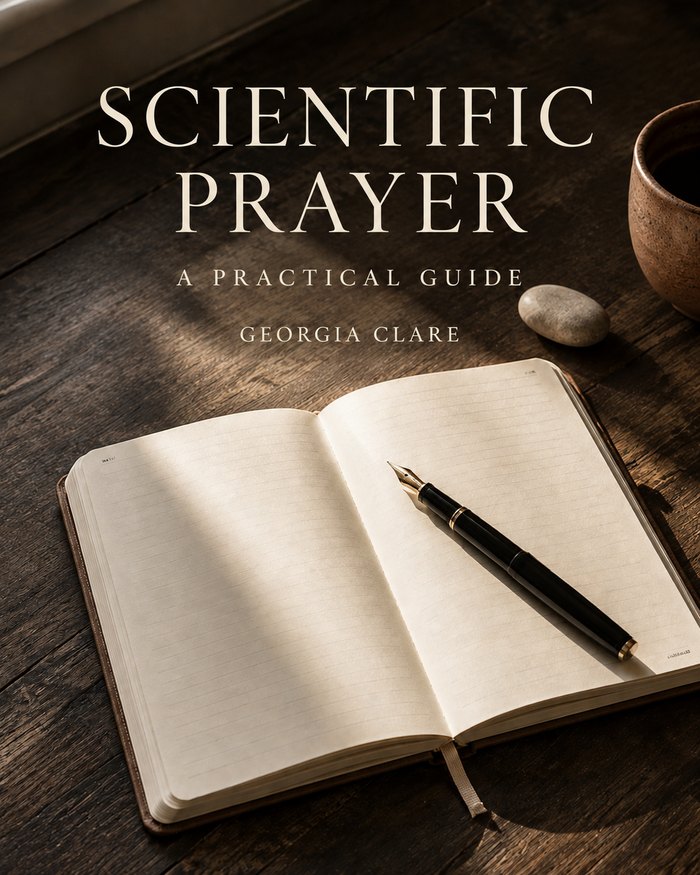
Take it with you
The 5-Minute Scientific Prayer Guide
A printable one-page version of the practice, for beside the kettle or on the bedside table. The steps, the timings and space to write your own wording. Free, and I’ll send it straight to your inbox.
Send me the guide
In Practice
The morning it turned into
Mine didn’t start as anything deliberate. It assembled itself slowly, and this is roughly what it looks like now.
- Make a cup of tea.
- Sit down with it before touching my phone. This one turns out to matter more than all the rest.
- A few slow breaths, nothing elaborate.
- Usually a short meditation, though not always.
- Then a couple of minutes imagining how I’d like to feel by the end of the day. Not what I want to get done. How I want to be while I’m doing it.
- Some days I write it down. Some days I don’t.
That’s the whole thing. It looked far too simple to be worth doing, which is probably why it took me so long to take it seriously.
Worth Saying
What this isn’t
It isn’t a method for getting whatever you want. I’ve prayed for things that never happened and hoped for outcomes that never came. Heartbreak still hurts, illness still arrives, and no amount of careful wording prevents any of it.
It also isn’t positive thinking in the sense of pretending. Telling yourself everything is fine when it plainly isn’t tends to make the gap wider, not smaller.
What it does is more modest and more useful. It makes you aware of what you’re rehearsing. We are all in conversation with ourselves all day, and most of it goes unnoticed. Once you notice it, you get a say in it. That’s the whole of the benefit, and in my experience it’s a considerable one.
Alongside This
It works better with company
On its own this is one small habit. What changed things for me was combining it with the others, which is the idea behind synergy in healing. Each of these is fine alone. Together they hold each other up.
Morning Intention Setting
A guided meditation and journaling practice, which is the closest thing here to a scientific prayer session.
Before the Day Begins
A short morning practice for the few minutes before anything is asked of you.
Gratitude
The practice that trains attention towards what is already here, rather than what is missing.
From The Library
The longer story
This page is the method. If you’d like the thinking behind it, and how it changed what prayer meant to me after leaving the religious community I grew up in, I’ve written about it at length.
How Scientific Prayer Changed the Way I Think About Praying
A twelve-minute read on Joseph Murphy, the question that stopped me, and why the quiet conversations we have with ourselves matter more than we notice.
And if you’d like words from other people on believing a different future is possible, the Hope and Faith literary prescriptions gather books, poems and lines worth keeping.

You become, little by little, the person you repeatedly practise being.
Whether you call it prayer, meditation or simply sitting quietly with a cup of tea, the label matters far less than the practice. Every morning offers another chance to decide which thoughts to feed.
Browse the Meditation Library